
What are the limitations of PEEK machined parts?
As a supplier of PEEK Machined Parts, I've had the privilege of working closely with this remarkable material. PEEK, or polyether ether ketone, is a high - performance thermoplastic known for its outstanding mechanical, chemical, and thermal properties. It's widely used in various industries such as aerospace, medical, and automotive. However, like any material, PEEK machined parts also have their limitations.
1. High Cost
One of the most significant limitations of PEEK machined parts is the high cost. PEEK is an expensive raw material compared to other engineering plastics. The production process of PEEK resin itself is complex and requires strict control of reaction conditions, which drives up the cost. Additionally, machining PEEK is not an easy task. It demands specialized equipment and skilled operators. PEEK has a high melting point (around 343°C), which means that during machining, high - power tools are needed to cut through the material. The wear and tear on cutting tools are also more severe when machining PEEK, leading to increased tooling costs. For example, in the production of small - scale PEEK components for medical devices, the cost of raw materials and machining can be a significant burden for manufacturers, especially for those on a tight budget.
2. Difficult Machining
PEEK is a tough and rigid material, which makes it challenging to machine. During the machining process, PEEK has a tendency to generate a large amount of heat. If the heat is not properly dissipated, it can cause the material to deform or even burn. This requires the use of advanced cooling systems during machining, such as flood coolant or compressed air cooling. Moreover, the high strength of PEEK can lead to rapid tool wear. The cutting edges of tools can become dull quickly, which not only affects the machining accuracy but also increases the frequency of tool replacement. For instance, when machining PEEK into complex shapes like gears or turbine blades, the precision required is extremely high. Any deviation caused by tool wear or heat - induced deformation can render the part unusable.
3. Limited Design Flexibility
PEEK has a relatively high modulus of elasticity, which means it is less flexible compared to some other plastics. This limits the design possibilities, especially for applications that require parts to have a certain degree of flexibility or elasticity. For example, in some consumer products where parts need to bend or stretch slightly, PEEK may not be the best choice. In addition, PEEK's high melting point and viscosity make it difficult to form complex shapes through injection molding. Although machining can be used to create complex geometries, it is often more time - consuming and costly compared to injection molding. This restricts the design freedom in mass - production scenarios.
4. Chemical Compatibility Issues
While PEEK is generally resistant to a wide range of chemicals, it is not immune to all chemical environments. In some highly corrosive or reactive chemical solutions, PEEK may experience degradation. For example, in strong oxidizing agents or certain organic solvents, PEEK can undergo chemical reactions that change its physical and mechanical properties. This limits its use in industries such as chemical processing, where exposure to harsh chemicals is common. In a chemical plant, if PEEK parts are used in areas where they come into contact with concentrated acids or alkalis, the long - term performance of the parts may be compromised.

5. Surface Finish Challenges
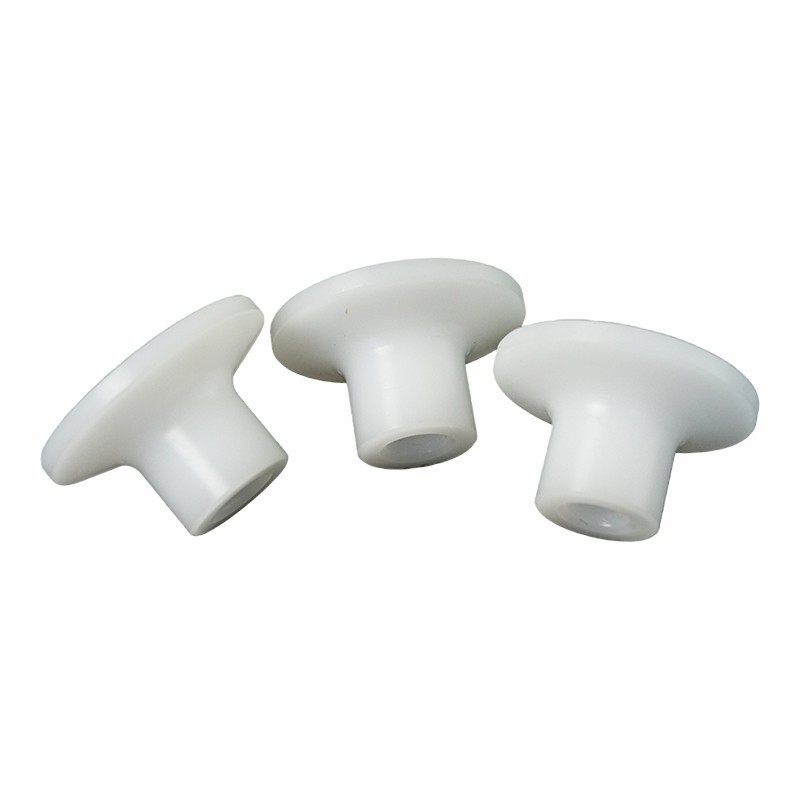
Achieving a high - quality surface finish on PEEK machined parts can be difficult. Due to its hardness and the nature of the machining process, PEEK parts often have a rough surface after machining. Post - machining processes such as polishing are required to improve the surface finish. However, polishing PEEK is not straightforward. The material's high strength and heat resistance make it difficult to remove small surface irregularities. In applications where a smooth surface is crucial, such as in medical implants or optical components, achieving the desired surface finish can be a time - consuming and costly process.
Comparison with Other Plastic Parts
When compared to CNC Machined Plastic Parts made from other materials like POM Plastic Turning Parts, PEEK's limitations become more apparent. POM, or polyoxymethylene, is a more cost - effective material with better machinability. It has a lower melting point and is easier to cut, which reduces tool wear and machining costs. POM also has better flexibility, making it suitable for applications where parts need to bend or flex. However, PEEK outperforms POM in terms of thermal stability and chemical resistance.
Overcoming the Limitations
Despite these limitations, there are ways to overcome them. For the high - cost issue, suppliers can work closely with customers to optimize the design of parts, reducing the amount of PEEK used without sacrificing performance. In terms of machining difficulties, advanced machining techniques and tool coatings can be employed to improve tool life and reduce heat generation. For chemical compatibility issues, surface treatments or protective coatings can be applied to enhance the chemical resistance of PEEK parts.
Conclusion
In conclusion, while PEEK machined parts offer many advantages, they also come with several limitations. These limitations should be carefully considered when selecting materials for a particular application. As a supplier of PEEK machined parts, we are committed to helping our customers understand these limitations and finding solutions to overcome them. If you are interested in PEEK Machined Parts or have any questions about their applications and limitations, please feel free to contact us for a detailed discussion and procurement negotiation.
References
- "High - Performance Polymers: Their Synthesis, Properties, and Applications" by K. L. Mittal.
- "Engineering Plastics: Properties and Applications" by David A. DeGroot.